
The Nar Phu Valley Trek is a restricted-area journey into two hidden Tibetan villages tucked behind the Annapurna massif, crossing the Kang La Pass at 5,240 m before dropping into the Annapurna Circuit at Ngawal. This 12-day guided itinerary keeps a slow acclimatization curve because Phu, Nar, and the pass all sit above 4,000 m, and the region rewards steady walking, not speed. You leave the tourist traffic of Chame behind at Koto and enter a valley the Nepal government only opened to foreign trekkers in 2003.
A Restricted-Area Route Led by Guides Who Know the Valley
A licensed guide, a special Nar Phu restricted area permit, and a minimum group of two are required by law inside this area. Our guides carry the paperwork, check you through the Koto checkpoint, and stay with you every day above the tree line. Above Meta, teahouses are sparse and beds are limited, so we book your rooms ahead in each village and hold them until the group arrives.
Living the Culture of Nar and Phu
Nar and Phu are not scenery. They are working villages where families still herd yaks, spin wool by hand, and gather at Tashi Lhakhang Gompa for morning puja. Your teahouse hosts speak a local Tibeto-Burman dialect closer to classical Tibetan than to Nepali, and most households in Phu are related to each other. Evenings are quiet, meals are shared around a stove, and the mountains close over the valley by five in the afternoon.
Why We Recommend 12 Days for the Nar Phu Valley Trek
12 days gives the itinerary two proper acclimatization steps before Kang La Pass, one at Meta and one at Phu, and still leaves room for the long descent day to Ngawal and the drive back to Kathmandu. Shorter 9 or 10 day versions of the Nar Phu Valley Trek exist, and we run them when a group asks, but they compress either the drive in or the acclimatization at Phu. For a first Himalayan pass above 5,000 m, that trade is usually the wrong one to make.
Our goal is simple: cross Kang La safely with enough fuel left to enjoy the view, not to book the shortest possible itinerary and hope your body cooperates.
Who This Nar Phu Valley Trek Is For
This trek suits walkers who have done at least one multi-day hike before and who want a route with fewer than a hundred foreign trekkers on it in a typical season. Age matters less than attitude here. We have taken parents in their fifties and gap-year students in their twenties over Kang La in the same group.
Who This Trek Is Not For
This trek is not for everyone, and knowing that before you book saves everyone time.
You want luxury accommodation throughout. Teahouses in Phu and Nar are basic stone-and-timber lodges with shared toilets and no heating outside the dining room. If comfort is a priority, our Annapurna Base Camp Trek or a lodge-based Everest itinerary is a better fit.
You want to trek solo. The Nar Phu Valley is a restricted area under Nepal government rules, and solo trekking is not permitted. A minimum of two trekkers plus a licensed guide is required to obtain the permit at all.
You need a fixed weather-proof timetable. Kang La is a snow-affected pass. In an unusual storm cycle we may hold the group at Nar for a day, or in a bad year reverse the itinerary to exit the way you came. If a rigid schedule is essential, a lower-altitude trek is safer for your calendar.
The Nar Phu Valley Trek reaches 5,240 m, with four consecutive nights above 3,500 m. If you have a heart, lung, mobility, or other health condition that may affect your ability to trek at altitude, speak with your doctor or a travel-medicine specialist before booking. Your guide can monitor you on the trail, but medical clearance and appropriate preparation should come first.
Trip Highlights
Journey Highlights
Kang La Pass (5,240 m): The High Point of the Route
Kang La Pass connects the Nar Phu valleys to the Manang side of the Annapurna Circuit and is the highest point of this trek. From the top, the panorama sweeps across Annapurna II (7,937 m), Gangapurna (7,455 m), Tilicho Peak (7,134 m), and the Chulu ridge. You start before sunrise from Nar and reach the pass in three to four hours.
Phu Village (4,080 m): A Working Tibetan Settlement
Phu is a compact stone village of around 30 households built against a rock face at the head of the valley. Yak herding and wool weaving are still the local economy. You sleep two nights here, use the middle day for a hike toward Himlung Himal Base Camp, and share meals with families who have lived at this elevation for centuries.
Tashi Lhakhang Gompa: Over 700 Years of Practice
This Nyingma monastery above Phu is believed to be more than 700 years old and remains the spiritual anchor of the community. The temple houses old thangkas, hand-copied scriptures, and a small collection of ritual instruments. Your guide will explain when photography is welcome and when it is not.
Nar Phedi Nunnery: Sleeping Inside a Monastery
On the way from Phu back toward Nar, the itinerary drops to Nar Phedi, a working nunnery that hosts trekkers in a simple guest wing. Evening puja begins around five and guests are welcome to sit quietly at the back. It is one of the more memorable nights on any trek in Nepal.
The Chorten Row Above Nar (4,110 m)
The final approach to Nar village passes a long row of hand-built chortens with bamboo caps, painted white against the red rock behind them. It is the single most photographed section of the trek, and it earns the attention.
Why Book the Nar Phu Valley Trek with Sublime Trails?
Most agencies in Kathmandu can put a Nar Phu Valley Trek itinerary in a PDF. The real difference is who handles the permit paperwork, who walks with you above Meta, and how honestly we talk to you when the weather at Kang La turns. Here is what you can expect when you book the Nar Phu Valley Trek with Sublime Trails, and if you want to hear it from past guests instead of us, our TripAdvisor reviews are the honest version.
You reach the people actually planning your trek.
Ram, Kabiraj, and Bhanuka handle trips and tours together. Ram started as a porter in 2005 and founded the company in 2014. Kabiraj and Bhanuka cover operations, guide coordination, and client communication alongside him. When you message us before your trek, one of the three is answering, not a booking desk.
Guides who have run the restricted-area routes for years.
The Nar Phu Valley is not a route you learn from a guidebook. Our lead guides have crossed Kang La in every season, know which teahouse in Meta actually keeps a working stove, and know which morning to wake you in Nar based on the previous evening cloud line. That pattern recognition matters more here than on Everest Base Camp, because there are fewer backup options if a day goes wrong.
Small groups, not filled buses.
Teahouse capacity in Phu and Nar is genuinely limited. We cap our Nar Phu Valley Trek group sizes so every person has a bed in every village, and so your guide can watch how each trekker is adjusting to altitude before the Kang La push.
Registered, taxed, and accountable.
We are registered with Nepal Department of Tourism as Sublime Trails Pvt. Ltd., and we maintain VAT and PAN compliance. That matters at 5,200 m, because it means there is a real, legally accountable company standing behind your trip.
A team that works the wider Annapurna and Manaslu region.
We also run treks in Manaslu, Annapurna Circuit, Upper Mustang, and Langtang. Guides who cross between these regions read weather, altitude, and pass conditions differently, and that experience feeds directly into how we plan the Nar Phu itinerary and its Kang La day.
You pay for what we quote.
The trek cost we send you is the full trek cost. ACAP, restricted area permit, TIMS, guide and porter wages, teahouse rooms, and standard meals on the trail are inside the number. The Nar Phu restricted area permit is billed at government rate with no markup.
What Happens if the Weather Closes Kang La Pass?
Kang La Pass is the crux of the Nar Phu Valley Trek and, unlike Everest Base Camp, there is no obvious plan B once you are already above 4,000 m. Fresh snow, low cloud, or high wind can make the pass unsafe on a specific morning. We plan for this before you leave Kathmandu, not on the day.
Step 1: We watch the forecast from Nar. Your guide checks the mountain weather from Nar village the afternoon before the crossing. If the forecast is clean, you leave before dawn. If it is not, we hold at Nar for an extra night and try the next morning.
Step 2: One buffer day is built into the itinerary. Our 12-day plan carries one flex day that can be spent at Nar without disrupting the drive back to Kathmandu. If Kang La is closed on your scheduled morning, we use it there.
Step 3: If two days are lost, we reverse direction. If Kang La stays closed for two consecutive mornings, the safest option is to descend the way you came, back through Meta and Koto to Chame, and drive out on the Annapurna Circuit road. This keeps the group safe and out of the high camps, and we handle the vehicle change on the day.
Step 4: Medical evacuation if a trekker cannot walk. Helicopter evacuation from Phu, Nar, or Meta is possible in daylight and clear weather. This is billed at cost to the trekker and requires travel insurance that covers high-altitude helicopter rescue. See the Safety section below for how the rescue call is made.
Who pays for what
Standard 12-day Nar Phu Valley Trek itinerary as quoted: included in your package.
- One extra teahouse night at Nar if Kang La is closed on your scheduled morning: included, no extra charge.
- Second and further extra nights caused by prolonged weather closure: you cover teahouse and meal costs at cost.
- Reversal drive from Chame to Kathmandu instead of Besisahar: we handle the transport change, cost difference is minimal and covered.
- Helicopter evacuation from Phu, Nar, Meta, or Ngawal: you cover it, billed at cost with no Sublime Trails markup, insurance permitting.
What is refundable
- The ACAP permit and Nar Phu restricted area permit are non-refundable once issued. This is a Nepal government rule, not ours.
- Teahouse deposits already paid on your behalf in the villages are non-refundable.
- Unused portions of the guided service on a shortened itinerary are refunded on a pro-rata basis where operationally possible.
Getting There
Kathmandu Tribhuvan International Airport is served by direct and one-stop flights from most major hubs in Asia and the Gulf. Trekkers from the US, Europe, and Australia typically connect through Doha, Istanbul, Delhi, Singapore, or Bangkok.
From Kathmandu, the Nar Phu Valley Trek begins with a long road day to Dharapani. Unlike the Everest region, there is no domestic flight involved, so the trip is not exposed to Lukla weather risk. The trade-off is a nine to ten hour drive on the way in and a five to six hour drive on the way out.
A Sublime Trails representative will meet you at the airport and stay with you through the transfer to your Kathmandu hotel.
Cost Details
Inclusions & Exclusions
What’s Included
Accommodation
- 3-star Kathmandu hotel for 2 nights on a twin-sharing basis
- Comfortable teahouse accommodation during the trek for 9 nights
- One night at Nar Phedi Nunnery guest wing
- Rooms with attached bathrooms where available in the villages
Transportation
- Private airport transfers on arrival and departure
- Kathmandu to Dharapani private vehicle plus 4WD from Besisahar
- Pisang to Besisahar shared jeep and Besisahar to Kathmandu private vehicle
Meals and Drinking Water
- 11 breakfasts, 10 lunches, and 9 dinners during the trek
- Fresh seasonal fruit during the trek where available
- Safe boiled drinking water, up to 3 litres per day
- Farewell dinner in Kathmandu
Guides and Porters
- Experienced licensed Nepali trekking guide with restricted area training
- Assistant guide where required by group size
- One porter for every two trekkers, carrying up to 25 kg
- Guide and porter salaries, meals, insurance, and accommodation
Permits and Government Fees
- Annapurna Conservation Area Permit (ACAP)
- Nar Phu Valley Restricted Area Permit for the required duration
- TIMS card where applicable
- Applicable government taxes and paperwork
Trekking Gear
- Down jacket rated to approximately minus 20 degrees Celsius
- Sleeping bag
- Sublime Trails duffel bag for porter carry
- Sublime Trails cotton T-shirt as a keepsake
Connectivity and Safety
- Fingertip pulse oximeter for daily altitude monitoring
- Comprehensive first-aid kit carried by the guide
- Satellite communication device from Meta onward
- Guide-led altitude monitoring from Day 4 of the trek
What’s Excluded
Travel and Insurance
- Travel and rescue insurance including high-altitude helicopter evacuation to at least 6,000 m
- Medical expenses beyond first aid provided by the trekking team
- Costs arising from personal evacuation or repatriation
Flights and Transportation
- International flights to and from Nepal
- Domestic flight costs caused by personal itinerary changes
- Transportation or accommodation costs from personal delays or missed connections
Accommodation
- Extra nights in Kathmandu beyond the 2 included nights
- Additional teahouse nights caused by personal itinerary changes
- Room upgrades where available
Food and Drinks
- Alcoholic and non-alcoholic drinks
- Bottled mineral water
- Personal snacks and specialty food
- Meals outside the included trek itinerary
Personal Expenses
- Wi-Fi and charging fees at teahouses above Meta
- Personal shopping and souvenirs
- Laundry
- Personal trekking equipment not listed under inclusions
Tips
- Tips for guides, assistant guides, and porters
Other
- Costs caused by itinerary changes requested by the trekker
- Any services not specifically mentioned under What is Included
Local Guide
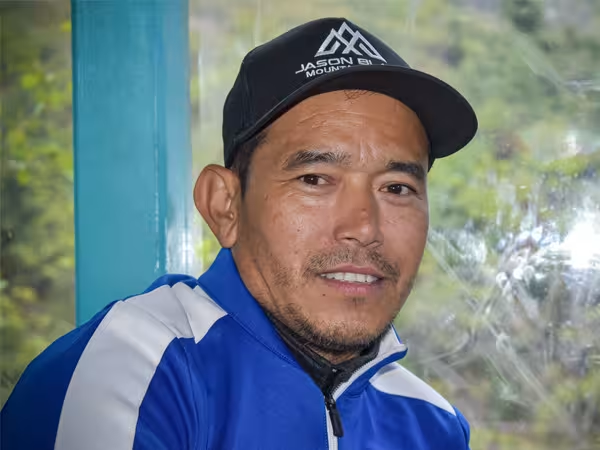
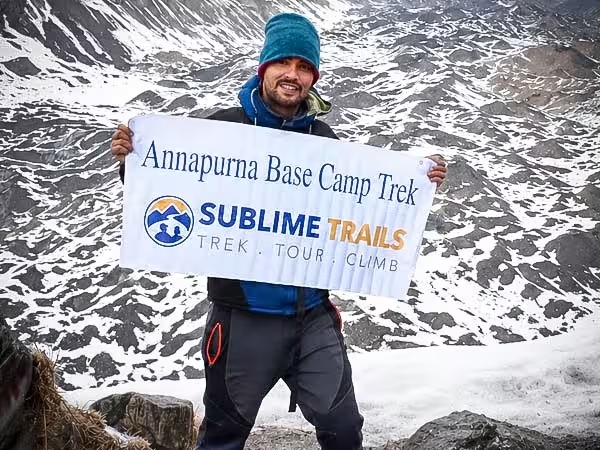
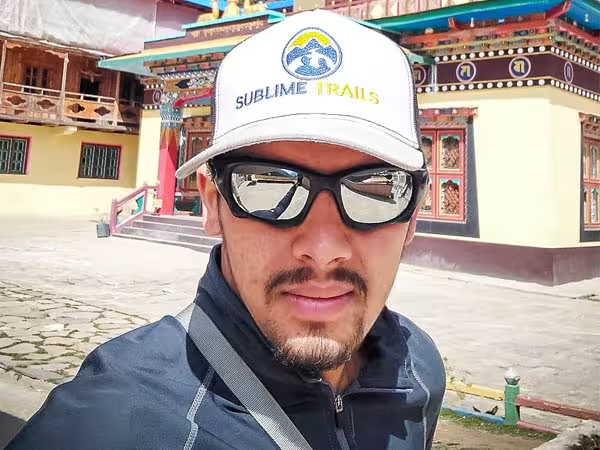
Meet Our Local Guide
Food and Accommodation
What You’ll Eat & Where You’ll Stay
Across this trek, you will eat around 30 meals between Dharapani and Ngawal. Teahouses along the route serve simple, filling food built for people burning close to 2,000 calories a day at altitude. Nothing fancy, everything hot, and more of it than you probably expect. Prices and variety narrow as you climb, and above Meta the menu shortens noticeably.
Vegetarian, vegan, or food allergy?
Tell us before you leave Kathmandu, ideally at your pre-trek briefing, and we handle it from there.
- Vegetarian is easy as most teahouse menus above Chame are already meat-free by default, since fresh meat has to be carried up on someone back.
- Vegan is doable where we brief your guide so eggs, butter, cheese, and milk get swapped out at every stop without you having to explain it three times a day. Above Meta the vegan options narrow, so plan for repetition.
- Gluten-free, nut allergy, lactose intolerance, or anything else, write it on your booking form or message us before departure. Your guide carries the list and speaks to the kitchen at every teahouse before you sit down.
Water, tea, and coffee are on every menu. Bring your own reusable bottle. We help you fill it with boiled or filtered water along the way so you are not buying plastic at 4,000 m.
Note: Below listed items are the common food available on the Nar Phu route.
A note from the guides: Most of them eat Dal Bhat twice a day, every day, and there is a reason. The refills are free, the rice and lentils digest well at altitude, and it is the one meal every teahouse cook makes properly because they have made it their whole life.
Equipment list
Nar Phu Valley Trek Equipment list

Know before you go! Some stuff we’ll provide, other things you’ll need to bring.
Training & Preparation
You do not need to be an athlete, but you do need a real training block. Kang La at 5,240 m is one of the more physically demanding pass days in Nepal. Starting your training early will help you feel stronger during the long day over the pass and the steep descent to Ngawal.
- Cardio, 3 to 4 times a week. Hiking, running, cycling, or the stair machine, building toward sessions of 60 to 90 minutes. The goal is not speed. It is sustaining effort for hours, which is what most days on this trek ask of you.
- Load-bearing hikes. Walk with a daypack holding 5 to 8 kg at least once a week before you leave. Carrying weight changes how your body handles hills. There is no substitute for practicing it.
- Stairs and hills. This route is almost entirely up or down, rarely flat. Use a stadium, a parking garage, or a steep local trail if you have access to one.
- Leg strength for the Kang La descent. Squats and lunges, twice a week. The 1,580 m drop from the pass to Ngawal is where sore quads happen, and that is usually a training gap, not an altitude problem.
- Break in your boots properly. Walk at least 30 to 40 km in them before you fly, not just around the house.
Fitness does not prevent altitude sickness. Worth saying plainly: a strong training block improves your experience and lowers injury risk. It does not protect you from AMS, which depends on acclimatization pace and individual physiology, not fitness level. Do not let good training create false confidence about skipping rest days at Meta and Phu.
Essential
Know Everything Before You Go Nar Phu Valley Trek
Nar Phu Restricted Area Permit
The Nar Phu Valley sits inside a Nepal government restricted area. Every trekker needs three permits: the Annapurna Conservation Area Permit (ACAP), a Nar Phu Valley restricted area permit, and, on some routes, a TIMS card. Permit costs at the time of writing are USD 30 for ACAP, USD 100 per week per person for the restricted area permit in the main September to November season, and USD 75 per week per person in the December to August window. Fees are set by the Nepal Ministry of Home Affairs and Nepal Tourism Board and can change, so confirm current rates against
the Nepal Tourism Board website before final booking. We build the current fee into your quote and update it if the government rate changes between booking and departure.
The restricted area permit requires a minimum group of two trekkers, a licensed guide, and a registered trekking agency to apply. Solo permits are not issued.
Currency and ATMs
Exchange currency in Kathmandu before departure. There are no ATMs anywhere on the Nar Phu Valley Trek route above Chame, and no card facilities in Phu or Nar. Carry the Nepali rupee equivalent of at least USD 250 in cash for personal spending beyond what your package covers, plus a separate reserve for guide and porter tips at the end.
Travel Insurance
Travel insurance is not required to enter Nepal or obtain a visa. It is required by us before you can start the Nar Phu Valley Trek, and by essentially every reputable operator running restricted-area routes. Nepal immigration does not check for it. We do.
Your policy needs three specific things. First, high-altitude coverage to at least 6,000 m. Most standard travel policies cap out around 2,500 to 3,000 m and will not pay out above that, so a policy that looks fine on paper can be worthless exactly when you need it. Kang La sits at 5,240 m, so this trek clearly requires the higher tier.
Second, helicopter evacuation coverage. A rescue from Phu, Nar, or Meta to Kathmandu typically costs USD 5,000 to 15,000 out of pocket without it. Third, trip interruption coverage in case of pass closure or landslide delay on the road out.
Buy your policy before you leave home. Insurers generally treat coverage bought after departure as higher risk, and some exclude pre-existing conditions or early symptoms entirely if the policy started after you had already begun travelling.
Nepal Visa
Most nationalities, including US, UK, EU, Australian, and Canadian citizens, can get a Nepal visa on arrival at Tribhuvan International Airport. You can also apply online in advance to save time at immigration. A 30-day visa is the right choice for the 12-day Nar Phu Valley Trek plus buffer days. Indian citizens do not need a visa. Bring a valid passport with at least six months validity, two passport photos, and the visa fee in USD cash.
Travel Etiquette
- Always pass mani walls, chortens, and prayer wheels on your left, walking clockwise. This is a real Buddhist observance, not a suggestion.
- Ask before photographing monks, nuns, or people directly. A smile and a gesture toward your camera is usually enough. A shaken head means no.
- Remove your shoes before entering a monastery prayer hall. Keep your voice low inside, and do not photograph inside Tashi Lhakhang or Nar Phedi unless your guide has confirmed it is welcome that day.
- Yield the trail to yaks, mules, and porters. Stay on the uphill side when you do. Loaded animals and porters have the right of way on this route because they are working.
- A small monastery donation is appreciated but never expected. Nothing above 500 rupees is needed. Drop it in the box, do not hand it to anyone.
- Dress modestly in villages, even in trekking gear. Covered shoulders and knees matter to local families whose homes double as your teahouse.
- Tipping is customary and matters more than it might seem. Guides and porters rely on it as real income. Ask your operator for a typical range at the pre-trek briefing rather than guessing.
Porter and Weight Limits
One porter carries up to 25 kg shared between two trekkers, so keep your personal duffel to around 12 to 13 kg to stay within that shared limit comfortably. Anything you leave in Kathmandu can be stored at your hotel for free during the trek.
Electricity and Connectivity
Electricity is available at every teahouse on the route, mostly from solar. Charging is free at Koto and Dharapani, and charged per device at teahouses above Meta, with fees rising with altitude. A power bank is worth carrying rather than relying on paid charging in Phu and Nar.
Mobile data through Ncell or NTC works reliably as far as Chame. Above Koto, coverage is patchy and drops entirely above Meta. There is no Wi-Fi in Phu or Nar. Your guide carries a satellite communication device from Meta onward for emergencies and for daily check-ins with our Kathmandu operations team.
Weather
The Nar Phu Valley Trek has two reliable trekking seasons: pre-monsoon spring (March to May) and post-monsoon autumn (late September to November). Both offer stable weather and the clearest views of Kang La and the surrounding peaks. October is the single most popular month, followed by April.
Temperature drops fast as you climb. Expect daytime highs around 15 to 20 degrees Celsius in the lower Marsyangdi valley, falling to 5 to 10 degrees Celsius at Meta (3,560 m), and between minus 5 and 5 degrees Celsius during the day at Phu and Nar, with nights regularly reaching minus 15 degrees Celsius at Nar in October and November. On the Kang La summit at sunrise, expect minus 10 to minus 20 degrees Celsius with wind chill. Pack in layers rather than for one temperature.
Winter (December to February) is walkable at lower altitudes but Kang La usually holds deep snow from mid-December onward, and we generally close the pass crossing for group departures during the deep winter months. If you want a winter Himalayan trek, the
Annapurna Base Camp Trek or a lower elevation Poon Hill trek is a safer choice.
Monsoon (June to August) is the one season we would steer most trekkers away from. Daily afternoon rain turns trails muddy, cloud cover hides the mountains you came to see, and landslides on the road between Besisahar and Chame become common. The Nar Phu Valley sits partly in a rain shadow and does fare better than Annapurna itself, but it is still the least reliable season for both walking and driving.