
One trek, three regions, and a culture most visitors to Nepal never encounter. Twelve days from Kathmandu: the Langtang valley to Kyanjin Gompa, a crossing to Gosainkunda Lake, then Lauribina Pass into Helambu's Hyolmo villages before descending to Melamchi. The most complete single itinerary we run through this part of Nepal, with a shorter finish available for trekkers who want the lake without the full Helambu extension.
Three regions, one continuous trail. This itinerary walks the Langtang valley to Kyanjin Gompa, crosses south to the sacred Gosainkunda Lake, then continues over Lauribina Pass into Helambu, home to the Hyolmo people, whose Buddhist culture and terraced villages feel distinct from anything earlier in the trip. It is the fullest single itinerary we run through this part of Nepal.
Why This Trek Covers Two Names at Once
Gosainkunda and Helambu are not two separate destinations you have to choose between. They sit on the same trail, one after the other. This itinerary walks to the lake first, then continues the same day's direction over Lauribina Pass into Helambu proper. If you've seen either name used alone elsewhere, both usually describe some version of this same route, sometimes stopping earlier, sometimes continuing further. We built this page around the complete version, and note exactly where a shorter finish is available if your schedule needs it.
Who This Is Actually For
Trekkers with about two weeks who want the fullest possible combination this region offers, high alpine scenery at Kyanjin Gompa, a sacred lake crossing, and genuine time in a third distinct culture beyond it. It suits returning Nepal trekkers more than first timers, since the itinerary asks for sustained multi day effort without the built in slack a shorter trek provides.
This is a fully guided, lodge based trek combining the Langtang Valley route to Kyanjin Gompa, an extension to Gosainkunda Lake, and a crossing of Lauribina Pass into Helambu, descending through Hyolmo villages toward Melamchi.
Trip Highlights
Journey Highlights
Gosainkunda Lake
4,380m, sacred to both Hindus and Buddhists.
Lauribina Pass
4,610m, the crossing into Helambu and the trip's second major high point
Melamchi Ghyang and Sermathang
genuine Hyolmo villages with monasteries and terraced farmland most Langtang trekkers never see
Tsergo Ri
a 4,984m viewpoint over Langtang Lirung, the trip's highest point overall
The Most Demanding of Our Three Langtang Treks
- Two genuine high points across twelve days, more than either standalone Langtang product.
A Consolidated Route, Not Two Separate Trips
- This replaces what used to be two separate itineraries, now run as one continuous trek with a single canonical route.
Hyolmo and Tamang Culture Are Genuinely Different
- Helambu's Hyolmo villages differ meaningfully from the Tamang communities earlier in the trek. Approach both with real curiosity.
You Return to a Different Town Than You Started
- This trek begins at Syabrubesi and ends at Melamchi Pul Bazaar, not a loop back to the same trailhead.
Itinerary
Langtang Gosainkunda Helambu Trek Detailed Itinerary
Day 1 - Kathmandu to Syabrubesi Drive
Our journey begins early with a scenic drive north from Kathmandu along the Pasang Lhamu Highway. As the road winds alongside the Trishuli River, watch terraced rice paddies give way to steep, pine-forested mountainsides. Past Dhunche, keep your camera ready for your first glimpse of Ganesh Himal (7,422 m). We’ll reach the lively trailhead town of Syabrubesi by late afternoon, where we'll gather over warm tea to review our gear and discuss tomorrow’s starting trail.
Day 2 - Syabrubesi to Lama Hotel Trek
Crossing the suspension bridge over the Bhote Koshi River officially kicks off your foot journey. The trail climbs steadily alongside the churning Langtang Khola under a dense forest canopy of oak, maple, and bamboo—keep an eye on the tree branches for gray langur monkeys and, if we're lucky, a shy Red Panda. After a lunch break at the riverside clearing of Bamboo, a short, steep push brings us to Rimche, followed by a gentle 20-minute walk into Lama Hotel, a snug cluster of lodges tucked deep into the gorge.
Day 3 - Lama Hotel to Langtang Village Trek
Leaving the forest canopy behind, the air turns crisp as we cross the 3,000-meter mark. At Ghoda Tabela, the valley opens into wide alpine pastures framed by towering Langtang Lirung (7,227 m). After checking in at the national park post, we walk past prayer wheels and carved stone mani walls into rebuilt Langtang Village. Reconstructed after the 2015 earthquake, this resilient Tamang settlement offers a warm welcome complete with hot sea-buckthorn tea.
Day 4 - Langtang Village to Kyanjin Gompa Trek
This is a shorter, intentionally paced walk designed to help your body adapt to the rising altitude. The path winds past traditional stone chortens and yak pastures where local herders graze their livestock during the summer. By lunchtime, we cross the wooden bridge over the Laja Khola and step into Kyanjin Gompa’s sweeping glacial amphitheater. Spend your afternoon visiting the village’s famous yak cheese factory, established in 1955 with Swiss expertise. It’s a great spot to sample fresh alpine cheese while watching the afternoon light hit the surrounding peaks.
Day 5 - Kyanjin Gompa Acclimatization (Tserko Ri Side Trip)
Today you’ll tackle Tserko Ri (4,984 m) before dawn with headlamps lit. The climb is demanding, but standing by the summit prayer flags at over 5,000 meters rewards you with a staggering 360-degree panorama of Langtang II, Yala Peak, and distant Tibetan borders before we descend back to Kyanjin for a warm bowl of soup.
Pacing Tip: Climbing Tserko Ri involves a steep, pre-dawn push over loose scree. If you prefer a gentler option or want to save your legs for the pass on Day 10, the flat walk toward Langshisha Kharka offers equally magnificent glacier views without the vertical grind.
Day 6 - Kyanjin Gompa to Lama Hotel Descent
With the high peaks behind us for now, we retrace our steps back down the valley. Descending makes breathing feel surprisingly effortless as oxygen levels rise with every kilometer. Dropping nearly 1,500 vertical meters gives you a fresh perspective on the valley's sheer rock walls and waterfalls before we settle back into the green shelter of Lama Hotel.
Day 7 - Lama Hotel to Thulo Syabru
Today’s route leaves the main valley trail for the village of Thulo Syabru. The path descends along the Langtang Khola to the junction before climbing steadily through lush forests of oak, rhododendron, and bamboo. As you gain elevation up the ridge, views of Ganesh Himal appear through the trees. The trail eventually reaches Thulo Syabru, a traditional Tamang village perched across a high hillside, offering a peaceful glimpse into hillside farming life away from the busy gorge below.
Day 8 - Thulo Syabru to Shin Gompa/Chandanbari Trek
We begin our climb toward the sacred high lakes today along a scenic ridge. The path climbs through quiet, moss-draped forests, passing through Dursagang and Phungkar, offering frequent overlooks across the valley floor below. By early afternoon, we arrive at Shin Gompa (also known as Chandanbari). This peaceful forest settlement is home to an ancient Buddhist monastery and a local cheese factory—a perfect place to rest and explore before tomorrow's alpine push.
Day 9 - Shin Gompa to Sacred Gosainkunda Lake Trek
Leaving the treeline behind at Cholangpati, we climb into high alpine tundra. Reaching the ridge top at Lauribinayak (3,910 m), the horizon opens up to a grand panorama spanning the Annapurnas, Manaslu, and the Ganesh Himal. The final stretch winds along a dramatic cliffside trail, passing the serene waters of Saraswati Kunda and Bhairav Kunda before reaching holy Gosainkunda Lake. Revered by both Hindus and Buddhists as the sacred abode of Lord Shiva, the lake is lined with peaceful stone shrines and fluttering prayer flags.
Day 10 - Gosainkunda over Lauribina La Pass to Ghopte
We leave the lake early, climbing past smaller glacial tarns to Lauribina La Pass (4,610 m)—the highest point on our circuit. Standing at the pass amid thousands of prayer flags offers an unforgettable sense of achievement. After celebrating at the top, we descend steeply over loose rock down to Phedi for a cup of hot tea. From there, the trail winds up and down through quiet forest overhangs until we reach the small wilderness settlement of Ghopte.
Safety Note: Today is the technical highlight of the loop. Trekking poles are highly recommended for the steep, boulder-strewn descent from the pass down to Phedi.
Day 11 - Ghopte to Melamchi Gaun Trek
Today we transition into the quiet Helambu region as we head east away from the wilderness passes. The trail weaves up and down along forested ridges before a steady climb brings us to Tharepati Pass (3,690 m), which offers a final sweeping look back at the Langtang peaks. From the ridge, a shaded descent leads down through thick fir and rhododendron forests directly into Melamchi Gaun. This charming Sherpa and Hyolmo village features traditional stone houses and an ancient monastery surrounded by terraced crops.
Day 12 - Trek from Melamchi Gaun to Tarkeghyang
Today’s leg features a direct valley crossing from one prominent ridge village to another. We exit Melamchi Gaun on a steep stone path, descending through terraced fields down to the rushing Melamchi Khola. After crossing the suspension bridge, the real work begins with a steady, four-hour uphill climb through cool forest switchbacks. The trail brings us to Tarkeghyang, a culturally rich settlement famous for its historic monastery—one of the oldest in Helambu—and its intricate wooden houses showcasing traditional Yolmo heritage.
Day 13 - Tarkeghyang to Sermathang Trek
We enjoy a much more relaxed trail today as we follow a sweeping, gradual ridge-line path with minimal elevation changes. The easy walk winds through quiet, shaded oak woods, across small mountain streams, and past traditional stone chortens. Throughout the afternoon, you can enjoy broad, clear views of the Jugal Himal range stretching across the northern horizon. The day finishes as we pull into Sermathang, a picturesque Yolmo village historically famous for its apple orchards and deep connections to traditional Tibetan Buddhism.
Day 14 - Descent to Melamchi Pul Bazar & Kathmandu Drive
Our final morning on the trail is a long, continuous descent from the high ridges through local farming settlements like Duwachaur. We follow stone paths down to the bustling market hub of Melamchi Pul Bazar, located at the confluence of the Melamchi and Indrawati rivers. Here, our private vehicle meets us for the drive back to the capital. As we travel along the river roads back into Kathmandu, you can sit back and reflect on an unforgettable 14-day journey across the valleys, sacred lakes, and high passes of Langtang and Helambu.
Getting There
The Langtang Gosainkunda Helambu Trek starts from Kathmandu, where you arrive at Tribhuvan International Airport. The city is connected to major destinations across Asia and the Gulf, with one-stop flights available for travelers coming from Europe, North America, and Australia through hubs such as Doha, Istanbul, Delhi, Singapore, and Bangkok.
After your arrival, we travel by road from Kathmandu to Syabrubesi, the main gateway to the Langtang Valley. The drive takes you through winding mountain roads, green hills, terraced fields, and small settlements, usually taking around 6 to 8 hours depending on traffic and road conditions.
A Sublime Trails representative will meet you at Tribhuvan International Airport and assist you with your arrival and transfer. We arrange the transportation and trekking logistics needed for the journey, allowing you to begin the trail toward Langtang Valley, Gosainkunda, and Helambu comfortably.
Map And Altitude Chart
Langtang Gosainkunda Helambu Trek Map and Altitude Chart
Interactive Map
Cost Details
Inclusions & Exclusions
What’s Included
- Ground transport: Kathmandu to Syabrubesi, plus return from Melamchi Pul Bazaar
- All teahouse accommodation and meals during the trek
- Licensed guide and porter (1 porter per 2 trekkers, up to 20kg)
- Langtang National Park permit and TIMS card
- Guide and porter insurance
What’s Excluded
- Travel insurance, including helicopter evacuation coverage (mandatory given this route's remote sections)
- Nepal visa fee
- Hot showers and personal expenses
- Guide and porter tips
Add-Ons
Optional Upgrades & Extras
Shorter finish via Kutumsang: ask us for a custom quote, since it changes your total days, permits, and return transport. Extra Kathmandu nights: US$35 to US$80 depending on hotel category. Extra Helambu rest day: US$75, including accommodation and meals.
Trip Departure
Dates & Booking
Cancellation Policy
Secure Payment
Saturday
17 Oct 2026
to
Wednesday
28 Oct 2026
Status
Guaranteed
Sunday
18 Oct 2026
to
Thursday
29 Oct 2026
Status
Guaranteed
Monday
19 Oct 2026
to
Friday
30 Oct 2026
Status
Guaranteed
Wednesday
21 Oct 2026
to
Sunday
01 Nov 2026
Status
Guaranteed
Friday
23 Oct 2026
to
Tuesday
03 Nov 2026
Status
Guaranteed
Saturday
24 Oct 2026
to
Wednesday
04 Nov 2026
Status
Guaranteed
Sunday
25 Oct 2026
to
Thursday
05 Nov 2026
Status
Guaranteed
Monday
26 Oct 2026
to
Friday
06 Nov 2026
Status
Guaranteed
Wednesday
28 Oct 2026
to
Sunday
08 Nov 2026
Status
Guaranteed
Friday
30 Oct 2026
to
Tuesday
10 Nov 2026
Status
Guaranteed
Saturday
31 Oct 2026
to
Wednesday
11 Nov 2026
Status
Guaranteed
Book at least 3 to 4 weeks ahead for permit processing. Days 7 and 8 are physically demanding and weather sensitive, so build a buffer day into your schedule if your dates allow it. Fixed group departures run monthly during peak season, March through May and September through November. Private departures are available on request.
Food and Accommodation
What You’ll Eat & Where You’ll Stay
Meals follow the standard Langtang teahouse pattern through Kyanjin Gompa and Gosainkunda, with dal bhat, noodle soups, and momos. Food variety generally improves once the route descends into Helambu's better established villages, particularly Melamchi Ghyang and Sermathang.
Equipment list
Langtang Gosainkunda Helambu Trek Equipment list
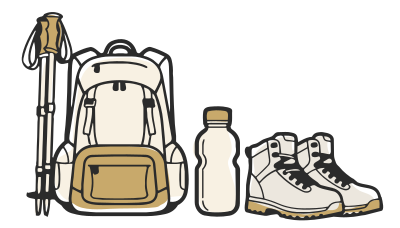
Know before you go! Some stuff we’ll provide, other things you’ll need to bring.
Reviews
Client’ Testimonials and their Experiences
C
Incredible Langtang Valley - Gosaikunda - Helambu Circuit Trek with Bibek and Ram!!
Incredible experience with Bibek and Ram on the Langtang-Gosaikunda-Helambu trekking circuit! From start to finish, even months out with planning the trek I felt incredibly comfortable, safe, well taken care of and supported throughout my planning for this trek. My guide and porter Bibek and Ram were knowledgable, helpful, kind, and so great to spend 14 days alongside. I really loved how local of an organization Sublime Trails is and how safety is a top priority. Thank you Sublime Trails team!!

Langtang Valley trek, wonderful time in Nepal.
I was desperate for short trek of around 10 days. I found one package to Langtang Valley by Sublime Trails. Actually, my friend recommended me this tour. He was in Nepal two years ago.
Mr. Ram Khadka assigned Mr. Ajit as my tour guide. Ajit was cool guide. He was fantastic photographer too. He was also constantly taking my care on trek. Our hike to Langtang Valley, Kyanjin Gompa and Kyanji Ri were awesome. Also, we hiked to cheese factory on the way. I had never tasted such fantastic fresh cheese. This trip was best for me. Also, I was able to be back on schedule.

Langtang trekking, Yet another trekking in Nepal
I knew this trek would be a bit harder than last because it is a long trek and I was physically and mentally prepared. Trekking in Nepal can challenges you in different ways, the altitude, temperature and how you pack for it. I want to thank Ram that he suggested that I should take extra blanket because of the cold weather. If I didn't I would be in great troubles, I am bad at coping with cold and he knows that from our last Everest Base Camp trek. That doesn't minimize my love for mountains and Nepal.
There were not many travellers this time because Langtang is not that popular destination like EBC but I have to say that I had one of the best experiences in my life. Everything went completely fine and my friends were happy too. If there would have been any problem they would literally kill me because I talked them into coming here. They had already trekked in such places but, they were in Nepal for the first time. I will come to Nepal again and again and there's no doubt that I will choose Sublime each time. The farewell dinner they planned for us was so amazing this time.
Moments
Hear It From Our Travelers
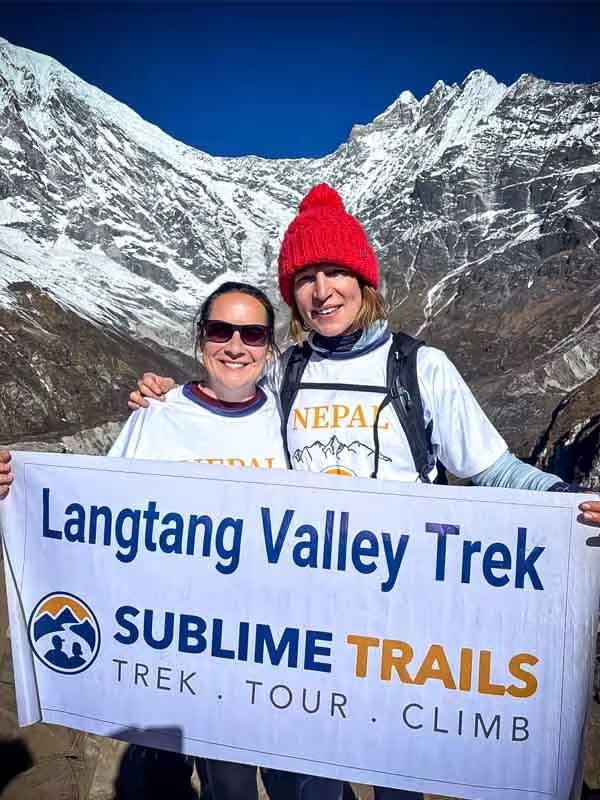
Sublime Trails Are Wonderful
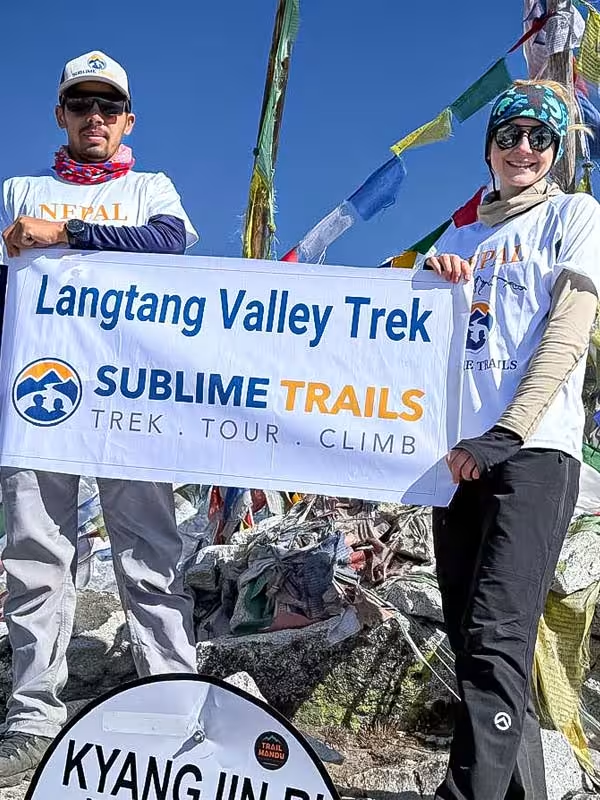
I've Never Been This High Before, But I'm Feeling Great.
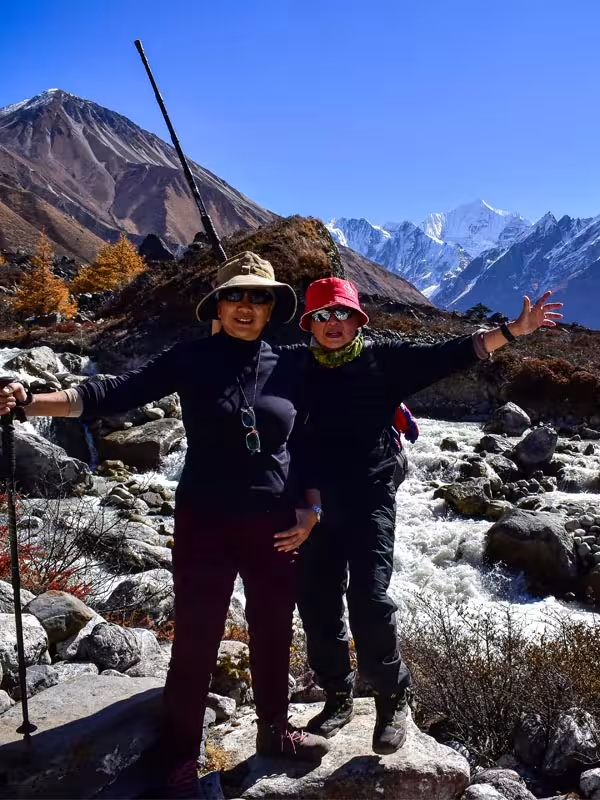
You Take Care of Me Like I'm Your Mother. I'm in Safe Hands.
Essential
Know Everything Before You Go Langtang Gosainkunda Helambu Trek
Currency & ATMs
Exchange currency in Kathmandu before departure. This itinerary starts by road and returns from Melamchi Pul Bazaar by road as well. ATMs do not exist beyond Syabrubesi and the larger Helambu villages. Carry sufficient cash for the middle stretch of the trek specifically.
Travel Insurance
Travel insurance is not legally required to enter Nepal or obtain a visa. It is required by us before you can start this trek, the same as every itinerary we run.
Your policy needs high-altitude coverage to at least 5,000m and helicopter evacuation coverage. This route includes both Tsergo Ri at 4,984m and Lauribina Pass at 4,610m. Confirm your policy covers the Gosainkunda and Helambu sections specifically, since evacuation logistics differ between these two regions.
Buy your policy before you leave home. Confirm it names both the demanding Days 7 and 8 explicitly. This route lacks the flight based evacuation speed our Everest products offer.
Nepal Visa
Most nationalities, including US, UK, EU, Australian, and Canadian citizens, can get a Nepal visa on arrival at Tribhuvan International Airport. You can also apply online in advance. A 15 day visa is tight for this twelve day itinerary. Choose 30 days for genuine buffer around weather delays. Indian citizens don't need a visa at all.
Travel Etiquette
- Always pass mani walls, chortens, and prayer wheels on your left, walking clockwise. This is a real Buddhist observance, not a suggestion, particularly in Helambu's Hyolmo villages.
- Ask before photographing monks, ceremonies, or people directly. A smile and a gesture toward your camera is usually enough. A shaken head means no, and that's the end of it.
- Remove your shoes before entering Kyanjin Gompa's prayer hall. Keep your voice low inside.
- Yield the trail to porters, yaks, and mule trains. Stay on the uphill side when you do, particularly on the narrow sections near Gosainkunda.
- A donation at Gosainkunda or any monastery along the route is appreciated but never expected. Don't make a show of it either way.
- Hyolmo culture in Helambu differs meaningfully from the Tamang villages earlier in this trek. Approach both with genuine curiosity rather than assuming they're the same.
- Tipping is customary, not mandatory, and matters more than it might seem. Guides and porters rely on it as real income. Ask your operator for a typical range rather than guessing.
Training for the Langtang Gosainkunda Helambu Trek
This is the most demanding of our three Langtang region treks, with two genuine high points across twelve days. Train accordingly, starting at least 10 weeks out.
- Cardio, 3 to 4 times a week, building toward 75 to 90 minute sessions. Days 6 through 8, the long descent to Thulo Syabru, the Gosainkunda push, and the Lauribina Pass crossing, form the most demanding stretch of the trip.
- Load-bearing hikes with a daypack at 6 to 8kg, at least once weekly in your final month. The pass crossing specifically demands sustained effort well beyond this region's gentler standalone trek.
- Prior high altitude experience is genuinely useful here, more so than on our standalone Langtang Valley Trek. This reflects the added demands of Gosainkunda and Lauribina Pass.
- Fitness doesn't prevent altitude sickness. Reaching two separate points above 4,600m in one itinerary demands real respect for acclimatization throughout.
Porter and Weight Limitation
One porter carries up to 18kg shared between two trekkers on this route. This is more than our standalone Langtang Valley Trek, given this itinerary's longer second half. Keep your personal duffel to around 10 to 12kg for comfortable sharing. There's no flight baggage limit to plan around, since this entire route is reached by road.
Electricity & Connectivity
Electricity and charging are free up to Lama Hotel. Costs increase progressively toward Gosainkunda and through Helambu, given the remoteness of both stretches. A power bank is essential for Days 7 through 9 specifically. Mobile data through NTC or Ncell is patchy above Thulo Syabru and largely absent near the pass.
Road Conditions: Syabrubesi and Melamchi Pul Bazaar
This trek uses road transport at both ends, with no domestic flight involved at any point, starting at Syabrubesi and ending at Melamchi Pul Bazaar, a different town from where you began.
The Kathmandu to Syabrubesi drive has improved significantly in recent years, though it remains winding for parts of the journey. The Melamchi Pul Bazaar to Kathmandu return is a more direct drive.
Monsoon season can affect road conditions on both ends of this route. We monitor conditions directly and will adjust your transfer timing if needed, given this itinerary's longer overall length.


