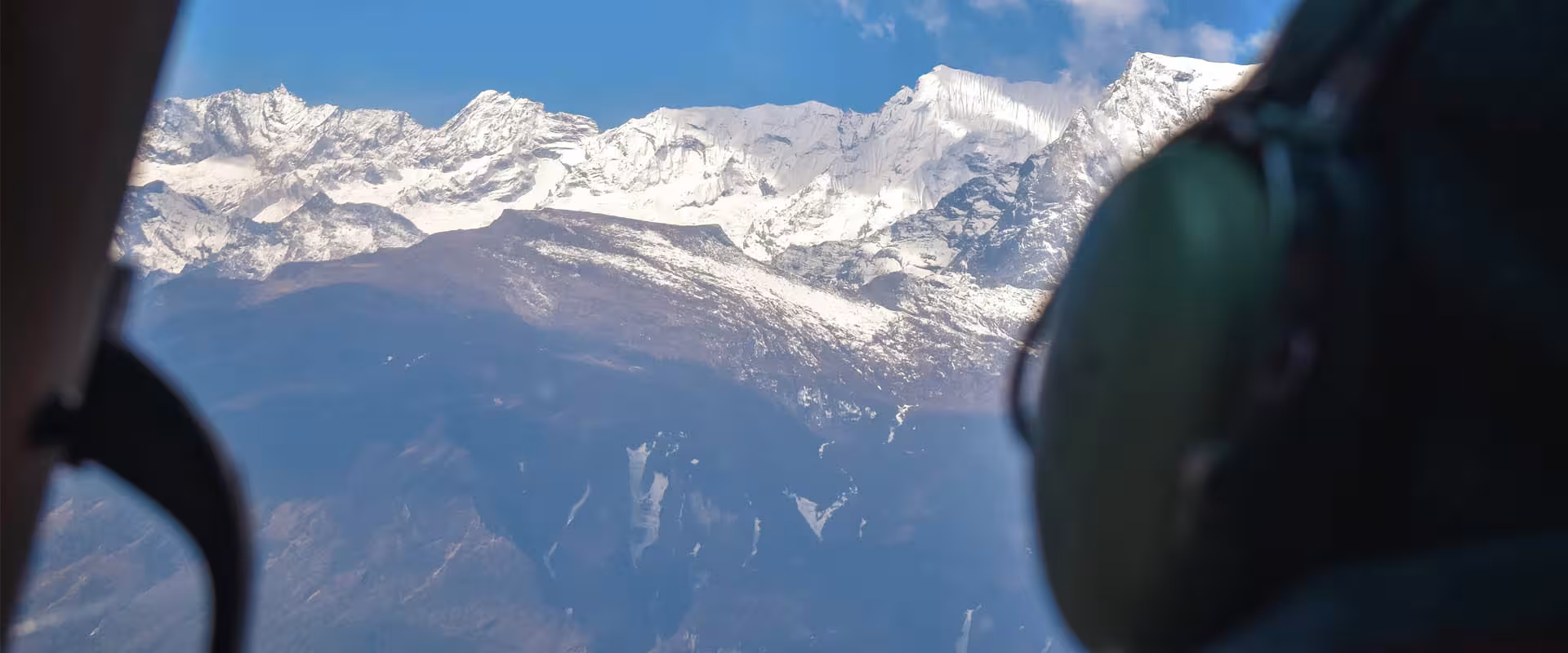
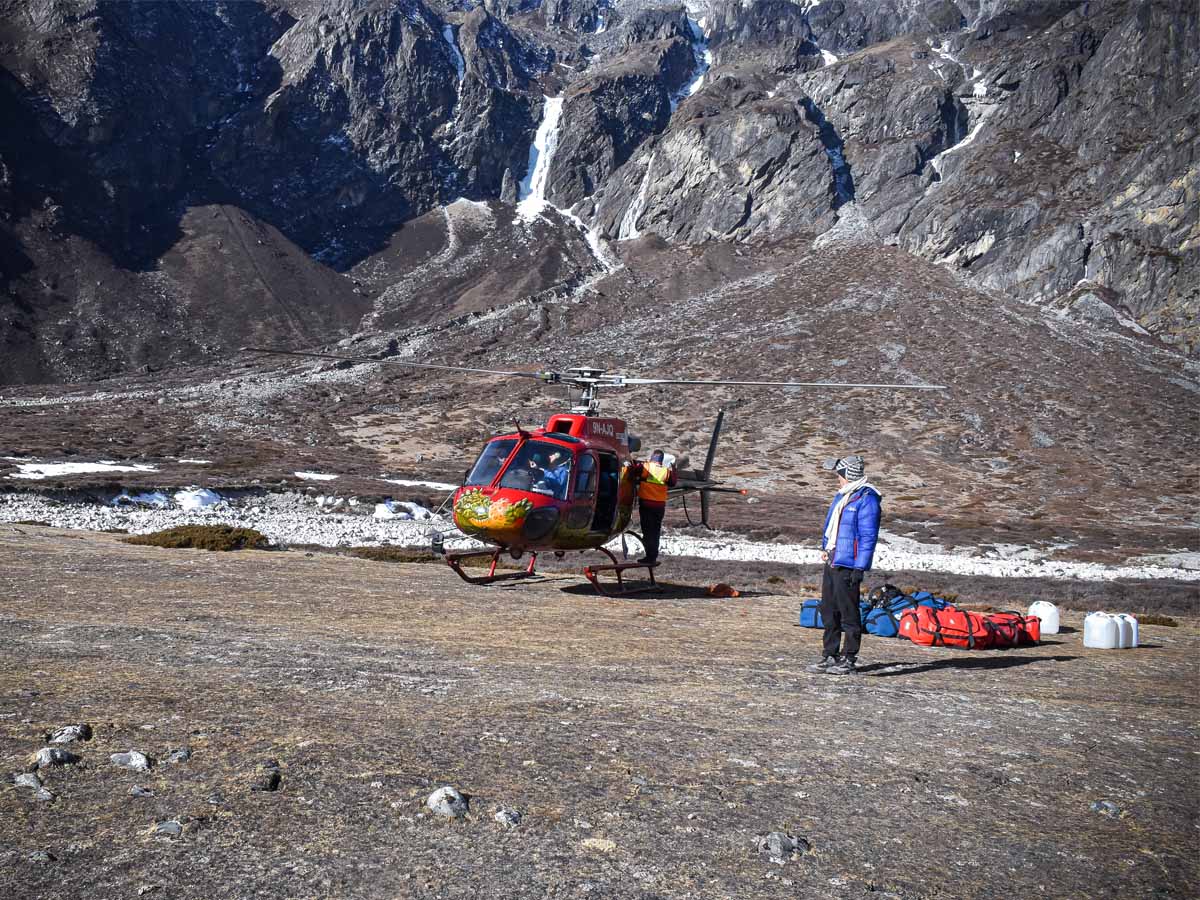
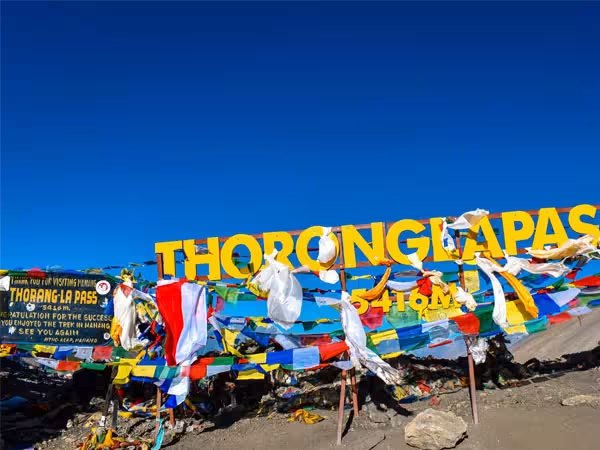
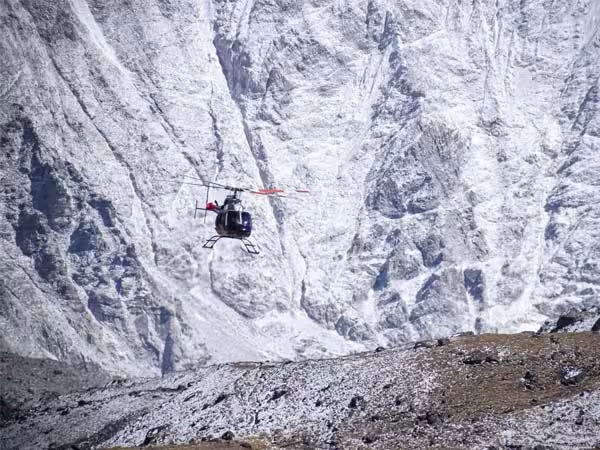
An Everest Base Camp helicopter tour can put you in front of some of the world's most recognizable mountains within a single day. But before you book one, there is more to understand than the departure time and the price. At Sublime Trails, we have found that travellers usually have the same practical questions before booking.
Where does the helicopter actually land?
Can it land at Everest Base Camp?
How long can you stay at Kala Patthar?
What happens if the weather changes?
Can you take your luggage?
And what happens if the planned landing cannot go ahead?
These questions matter because an Everest helicopter tour takes place in a high altitude environment where weather, aircraft performance and operating conditions can change the plan.
The experience is designed to make the Everest region accessible without a two week trek, but it is not simply a sightseeing flight where every detail can be guaranteed in advance.
Current high altitude travel guidance also highlights the effects of rapid exposure to altitude, while Nepal's aviation environment places safety and aircraft operating limits ahead of passenger preferences.
So, before you reserve your seat, here are 20 things we think every traveller should know about an Everest Base Camp helicopter tour.
You might imagine the helicopter landing directly at Everest Base Camp, giving you plenty of time to walk around the campsite and explore the area.
That is not the expectation you should have when booking a standard sightseeing flight.
Everest Base Camp sits at roughly 5,364 metres, while Kala Patthar rises to approximately 5,545 metres.
A typical sightseeing itinerary can provide an aerial view of the Everest Base Camp area and may use Kala Patthar as the high altitude landing point, subject to current operating conditions and the package you choose.
You should also understand the role of Hotel Everest View, which sits at a much lower altitude and is commonly used as a viewing or breakfast stop.
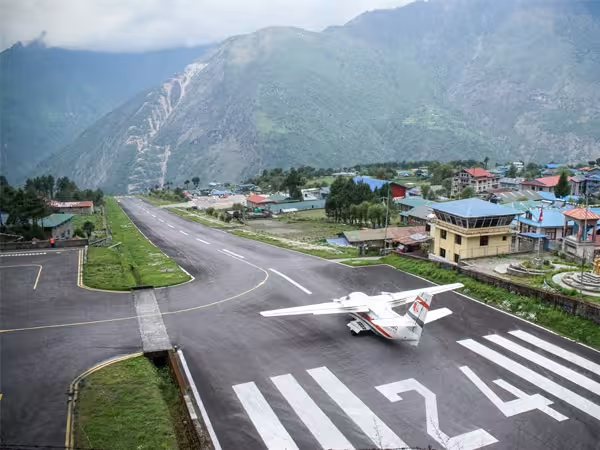
Lukla and Pheriche can also form part of the operational route depending on the aircraft, passenger load, weather and flight plan.
When we explain the experience at Sublime Trails, we prefer to separate these locations rather than treating them as one destination.
Everest Base Camp: Experienced as an aerial part of the route.
Kala Patthar: The high altitude viewpoint where a landing may be planned when conditions permit.
Hotel Everest View: A lower altitude stop where travellers can enjoy the mountain scenery in a more relaxed setting.
That simple distinction can prevent one of the biggest misunderstandings before booking.
2. A Helicopter Tour Is Not the Same Experience as Trekking to EBC
A helicopter tour and the Everest Base Camp Trek take you into the same remarkable region, but they give you very different experiences.
A trek is about the journey. You walk through villages, cross suspension bridges, spend nights in mountain lodges and gradually move deeper into the Khumbu. Your body has time to adjust to increasing altitude as the itinerary progresses.
A helicopter tour removes most of that journey.
You can see the mountains, glaciers, valleys and villages from above and reach the Everest region within a few hours rather than spending around two weeks on a traditional trekking itinerary. That makes the helicopter option particularly useful for travellers with limited time. It can also suit people who do not want to commit to prolonged walking or sleeping at high altitude.
But there is something you give up.
You are not experiencing the trail in the same way.
You are not gradually approaching Base Camp on foot.
You are not spending several mornings waking up in the Khumbu.
We do not think one experience needs to be presented as a replacement for the other. If you want the journey to Everest, trekking gives you that. If you want an efficient way to experience the Everest region from the air, the helicopter offers something different. The useful question is not which option is universally better.
Ask yourself:
Do I want the journey, or do I mainly want the Everest experience?
3. Mountain Weather Can Change the Entire Plan
When we talk about Everest helicopter flights with travellers, weather is one of the first things we discuss. Mountain weather is not as predictable as the timetable printed on your booking confirmation.
Cloud, wind and visibility can affect whether a flight departs, whether it can continue towards the planned destination and whether a high altitude landing is possible.
That can lead to a delayed departure, waiting at an intermediate location, a modified route, a different landing arrangement or a rescheduled flight.
It is also possible for a helicopter to operate while the mountain itself remains hidden behind cloud. That is an important distinction.
A confirmed flight does not mean guaranteed clear views.
Early morning departures are common because mountain conditions can change as the day develops. Even so, an early departure is not a promise of perfect visibility.
For this reason, we recommend leaving some flexibility in your Nepal itinerary. If your international flight leaves Kathmandu on the same day as your helicopter tour, a delay could create an unnecessary problem. A buffer day gives you more room to deal with weather related changes.
Before booking, ask the operator:
“What happens if weather prevents the planned flight or landing?”
The answer should be clear before you make payment.
4. A Short Flight Does Not Remove the Altitude
This is perhaps the most important health consideration to understand. A helicopter can take you from Kathmandu to an environment above 5,000 metres in a very short period. Your legs may not be doing the work of a trekker, but your body is still being exposed to very high altitude.
Everest Base Camp is a high altitude destination and the effects of altitude depend partly on elevation, rate of ascent and duration of exposure. People travelling rapidly to high altitude can face a greater risk of altitude illness because the body has had less time to acclimatise. That means you should not think of the helicopter tour as completely free from altitude concerns. Some people may experience headache, dizziness, nausea, fatigue or breathlessness after rapid exposure to altitude. The risk and severity vary between individuals.
If you have a medical condition that could be affected by rapid exposure to high altitude, speak with a qualified medical professional before booking. There is another important point. You do not sleep at Kala Patthar on a standard sightseeing tour. Your exposure is generally brief before the helicopter returns to a lower elevation. That is very different from spending several days trekking and sleeping progressively higher.
Still, short exposure is not the same as no exposure. We want travellers to know that before they book.
5. Do Not Expect to Spend an Hour at Kala Patthar
The photographs of Kala Patthar can make the place look like somewhere you could spend an entire morning exploring. A helicopter tour works differently. The high altitude landing is generally brief because of the elevation and the operational nature of the flight.
Your time on the ground can be limited to a short window, often around 10 to 15 minutes depending on the itinerary and operating conditions. Think of it as a focused mountain stop.
You land.
You step out.
You take in the view.
You take your photographs.
Then you return to the helicopter.
That means preparation matters. If you want a photograph with Everest in the background, have your camera or phone ready before the helicopter lands. If you want a few quiet moments simply looking at the mountains, do not spend every second checking your screen.
We often tell travellers that the most valuable photograph is sometimes the one you never take. You only have a short period at the high altitude viewpoint. Use it wisely. The goal is not to turn Kala Patthar into a long hiking stop. The goal is to experience an extraordinary viewpoint at an altitude that would otherwise require a serious trekking journey to reach.
6. Passenger Weight Can Affect the Flight Plan
Passenger weight is not an awkward question that operators ask for no reason. It is part of flight planning. Helicopter performance is affected by factors including altitude, temperature, fuel and total aircraft weight. As altitude increases, aircraft performance conditions change. That makes accurate passenger and baggage information important, particularly for high altitude operations.
So when an operator asks for your body weight, give an accurate figure. Do not guess simply because you are uncomfortable providing it. Do not deliberately provide an incorrect number. The operator may need to manage the passenger load, baggage or configuration of the flight according to the aircraft and current conditions.
This is especially relevant for shared flights where several passengers are travelling together. The final arrangement can depend on the aircraft, passenger weights, fuel requirements and operational conditions.
At Sublime Trails, we would rather explain this before departure than let a traveller discover it at the helipad. When booking, ask:
“How is passenger weight managed for the high altitude section of the flight?”
You should receive a straightforward answer.
7. Do Not Assume Your Main Luggage Goes With You
Your suitcase will be completely normal for a hotel stay in Kathmandu. It does not mean the same suitcase should automatically travel to the Everest region by helicopter. Aircraft payload has to be managed carefully, particularly during high altitude operations.
Passengers, fuel and baggage all contribute to the aircraft's overall weight. For that reason, you should ask about baggage before arriving at the airport. Find out how much cabin baggage is permitted and whether larger luggage remains in Kathmandu.
Load Distribuiton at Pheriche
If you are combining your helicopter flight with another Nepal itinerary, also ask whether luggage storage can be arranged. This is particularly useful if you have already checked out of your hotel.
We recommend asking four simple questions:
What baggage allowance applies to the flight?
Can I carry a small daypack?
Where will my main luggage stay?
Can excess luggage be stored safely?
Do not wait until the morning of the flight to find out. Your attention should be on the mountains, not on whether your suitcase has somewhere to go.
8. Understand What You Are Paying for With a Shared or Private Flight
The difference between a shared Everest helicopter tour and a private charter is not simply that one is cheap and the other is expensive. They are different booking arrangements.
A shared flight allows travellers to divide the aircraft cost with other passengers. That can make the experience more accessible, but you have less control over the schedule and passenger arrangement.
A private charter is more suitable when flexibility and privacy are important. It work well for couples, families or groups travelling together. You may have greater flexibility over timing and arrangements, subject to the aircraft, weather and aviation requirements.
However, private does not mean unlimited.
You still cannot demand a landing that the pilot considers unsafe.
You still have to follow aircraft weight limitations.
You still depend on mountain weather.
That is why we recommend comparing the actual benefits of each option rather than assuming private automatically means better. Ask what additional flexibility you are paying for.
If you are travelling alone, a shared flight may make practical sense. If you are travelling as a family and want greater control over your itinerary, a private charter may offer benefits that matter more to you. The right choice depends on the experience you want.
9. Check Whether the Quoted Price Is Actually All-Inclusive
The price displayed for an Everest helicopter tour does not always tell the whole story.
Different packages can include different services. Before comparing two prices, check what each one covers. You may need to ask whether the price includes:
Helicopter transportation
Hotel pickup and drop-off
Airport transfers
Applicable airport or local charges
Sagarmatha National Park entry
Landing or operational charges
Breakfast or refreshments
Guide or porter services, if advertised
Cancellation or rescheduling costs
The Nepal Tourism Board lists an entrance fee for Sagarmatha National Park for foreign visitors, but travellers should confirm the current applicable charge and whether it is included in their specific package.
This is why comparing only the headline price can be misleading. A cheaper package may simply include fewer services.
A higher priced package may include transfers, meals and other costs that you would otherwise pay separately. We believe travellers should be able to understand what they are paying for before confirming a booking. If you are unsure, ask:
“Can you give me a complete list of inclusions and exclusions?”
That makes the comparison much easier.
10. Read the Cancellation and Weather Policy Before Paying
Do not wait until your helicopter is grounded by bad weather to read the cancellation policy.Read it before booking. Mountain weather can interfere with flights, so every traveller should know what happens if the planned operation cannot take place.
Ask whether the company offers:
Same day waiting
Next day rescheduling
An alternative date
A partial refund
A full refund
Transfer to another available flight
Deductions for non-refundable charges
The exact policy varies between operators. You should also check the difference between a weather related cancellation and a passenger initiated cancellation. Those situations may have different terms.
If your international flight is scheduled soon after the helicopter tour, this becomes even more important. A rescheduled helicopter flight is only useful if your wider itinerary can accommodate it. We recommend saving the written cancellation policy with your booking documents. When conditions change, you will already know what the operator has agreed to do.
11. Know What Happens if Kala Patthar Cannot Be Used
A good itinerary should explain what happens if the planned high altitude landing cannot go ahead. The important word here is planned. A Kala Patthar landing can be part of the intended itinerary without being guaranteed in every possible condition.
Weather, visibility, aircraft performance and other operational factors can affect the decision. If the planned landing is not possible, the flight may need to use another suitable arrangement or return without the high altitude landing. The exact response depends on the circumstances and the operator's current procedures. This is why we recommend asking about the backup plan before you pay. Do not accept vague promises.
Ask:
“If Kala Patthar is not safe to land, what alternative does your company offer?”
That question tells you much more than a marketing statement ever could. We would rather set this expectation clearly before departure. The Himalayan environment cannot be controlled by an itinerary document. A good itinerary plans for the experience while leaving room for responsible operational decisions.
12. The Pilot Makes the Final Safety Decision
You may have paid for a private charter. You may have travelled across the world. You may have imagined one particular photograph from Kala Patthar. None of that changes the pilot's responsibility for the safe operation of the aircraft.
If conditions are unsuitable, the pilot must be able to change the plan.
If the aircraft cannot safely carry a particular passenger and baggage combination, the flight arrangement may need to change.
If visibility deteriorates, the pilot may decide not to continue towards a planned landing.
This principle should never be treated as a customer service inconvenience. It is part of responsible mountain aviation. As a traveller, you should never feel that you need to persuade the pilot to land because you have already paid. The correct approach is the opposite.
Safety takes priority over the itinerary.
That is also why we avoid suggesting that a landing will happen regardless of weather or aircraft limitations. An experienced travel company should help you understand the conditions that can affect your trip rather than hiding them.
13. A Confirmed Flight Does Not Guarantee a Clear Everest View
There are actually two different things you are hoping for on an Everest helicopter tour.
You want the flight to operate. You also want Everest to be visible. Those are not the same thing. A helicopter can fly safely while cloud covers Everest.
Haze can reduce visibility.
Wind can move snow across the landscape.
Cloud can sit around one peak while leaving another visible.
That means a successful flight does not automatically equal a perfect photograph. We think this is an important expectation to set before booking.
You can choose a suitable season.
You can plan an early departure.
You can monitor the forecast.
But you cannot control a cloud. That is simply part of travelling through a high mountain environment. If the weather allows clear views, you may get the kind of panorama you imagined. If the mountains are partly covered, you are still experiencing the Everest region from the air. The distinction is simple:
A flight can be operational even when visibility is imperfect.
14. Dress for Kala Patthar, Not Kathmandu
Kathmandu and Kala Patthar can feel like two different worlds on the same morning. You may leave your hotel in Kathmandu feeling comfortable. A short time later, you could be standing above 5,500 metres in cold and potentially windy conditions.
Your clothing should therefore be chosen for the highest point of your itinerary. We recommend bringing a warm insulated or down jacket, thermal layers, gloves, a warm hat and comfortable shoes. Sunglasses are particularly useful because bright conditions and snow can create strong glare. Sunscreen should also be part of your daypack.
You do not need to dress as if you are climbing Everest. You simply need to be prepared for a short period in a very cold, high altitude environment. This is where travellers sometimes get the balance wrong. They want to keep their luggage light, so they leave their warm clothing in the hotel.
We would rather you carry one extra warm layer than spend your short landing wishing you had packed it.
15. Prepare Your Camera and Batteries Before You Leave
Cold temperatures can affect battery performance. That matters when your time at the highest viewpoint is limited. Charge your phone and camera before leaving the hotel. If you have spare batteries, carry them appropriately.
Make sure you have enough storage space for photographs and video. A lens cloth is also useful because condensation, dust or fingerprints can quickly affect image quality. Do not wait until Kala Patthar to discover that your phone storage is full.
The same applies to your camera settings. If photography matters to you, prepare before the flight. You may have only a short time outside the helicopter. And when you finally reach the viewpoint, remember to look up.
The whole point of the journey is not to create a perfect collection of images. It is to experience the Himalayas. Take the photograph. Then put the camera down for a moment. Everest will look better through your own eyes than through a six inch screen.
16. Understand What the Everest View Hotel Stop Adds
The Everest View Hotel is a different experience from Kala Patthar. It sits at approximately 3,880 metres and offers a more relaxed environment for appreciating the Khumbu landscape. Depending on the package and operational schedule, travellers may stop there for breakfast or refreshments.
That makes it a useful contrast to the short high altitude stop. At Kala Patthar, the focus is on a brief experience at extreme elevation. At Hotel Everest View, you have a more comfortable setting in which to sit, eat and look across the mountains. The two stops should therefore not be treated as interchangeable.
If your itinerary includes Hotel Everest View, check exactly what is included.
Is breakfast included?
How long is the stop?
Is the stop dependent on weather and operating conditions?
What happens if the aircraft has to modify the route?
Getting these details beforehand gives you a clearer picture of the experience you are purchasing.
17. Ask Who Actually Operates the Helicopter
There is an important difference between the company arranging your trip and the company operating the aircraft.
Before booking, ask which helicopter operator will perform the flight. You can also ask what aircraft is planned and what happens if that aircraft becomes unavailable.
This is more useful than simply reading a sentence saying that the company uses “experienced pilots.” Specific information gives you a better understanding of the operation.
Nepal's aviation system includes regulatory oversight of helicopter operators through the Civil Aviation Authority of Nepal. For a traveller, the practical lesson is simple: ask who is operating your flight and make sure the booking information is clear about the aviation provider.
You can also ask:
Which helicopter operator is flying?
What aircraft type is planned?
Who is responsible for the flight?
What happens if the assigned aircraft becomes unavailable?
What happens if passenger weight changes the planned configuration?
You do not need to become an aviation specialist. You simply need to know who is responsible for the flight you are purchasing.
18. Check Emergency Arrangements and Your Travel Insurance
No traveller books a helicopter expecting an emergency. Still, responsible planning means understanding what happens if something unexpected occurs.Ask the operator what emergency and communication procedures apply to the flight.
Your travel insurance deserves the same attention. Do not assume that every standard travel insurance policy automatically covers helicopter activities or high altitude travel. Read the policy wording and check whether the activities included in your itinerary are covered.
If your policy includes emergency evacuation, understand the conditions under which that benefit applies. The health side deserves attention as well. The CDC notes that travellers with certain pre-existing conditions may need medical advice before travelling to high altitude.
This is particularly relevant for a helicopter tour because you can reach a very high elevation without the gradual ascent associated with trekking. A helicopter tour can be suitable for many travellers who do not want to undertake a long trek.
But limited walking does not mean zero altitude exposure. That is a distinction worth understanding before booking.
19. Be Careful With “Guaranteed” Language
We are deliberately careful with words such as guaranteed when describing an Everest helicopter tour. A company should not promise an Everest view regardless of weather. It should not promise a Kala Patthar landing regardless of conditions. It should not promise a fixed amount of time at high altitude regardless of aircraft performance and operational requirements. And it should certainly not suggest that a helicopter will operate regardless of weather.
Instead, The itinerary is planned around a Kala Patthar landing when weather, aircraft performance and operating conditions permit.
We believe this is the approach we prefer. We want travellers to book the experience they are actually going to receive, not an idealised version of it.
20. Know Whether an Everest Helicopter Tour Is Right for You
An Everest helicopter tour can make excellent sense for certain types of travellers.
You may have only a few days in Nepal.
You may not have enough time for a traditional EBC trek.
You may be travelling with family members who do not want to spend two weeks walking.
You may want to see the Khumbu from above.
Or perhaps you simply want a shorter way to experience the landscape around Mount Everest.
Those are all reasonable reasons to consider the flight. But there are also reasons to choose trekking instead. If you want to experience Sherpa villages at walking pace, stay in mountain lodges, acclimatise gradually and follow the trail towards Base Camp and return buy helicopter, EBC trek with helicopter return can help you to gain those experiences alongside helicopter experiences.
It offers something else. It compresses a huge landscape into a short journey. You can look down at valleys and glaciers from the air and then step into an extreme mountain environment without spending days walking there. That convenience is the central appeal. The trade off is that you spend less time immersed in the trail. So before booking, ask yourself what you want to remember from your Nepal trip.
If the answer is “I want to see Everest and the Khumbu when I have limited time,” a helicopter tour may fit naturally into your itinerary.
If the answer is “I want to walk to Everest Base Camp and experience the journey,” you should look more closely at the trek.
The choice should start with the experience you want, not simply the number on the price tag.
Conclusion
An Everest Base Camp helicopter tour is one of the most time efficient ways to experience the Everest region. But the best experience starts before you reach the helipad.
Know that Everest Base Camp is generally experienced as part of the aerial route rather than as a standard landing point. Understand the role of Kala Patthar. Know that the high altitude stop is short. Ask how passenger weight and baggage are handled. Check exactly what your price includes. Read the weather and cancellation policy. Find out what happens if the planned landing cannot go ahead. Ask who operates the helicopter.
Check your travel insurance. And most importantly, understand that the pilot's safety decision comes before any promised itinerary.
At Sublime Trails, we believe realistic information makes a better travel experience. The Himalayas are not a controlled environment. Weather can change. Cloud can cover Everest. Aircraft limitations can affect the route. A planned landing can become unavailable.
Those realities do not take away from the experience. They are simply part of travelling in the world's highest mountain range.
When you know what to expect, you can step into the helicopter with fewer assumptions and enjoy the journey for what it really is: a short, extraordinary view of the Everest region from above.
Ready to experience Everest from above? Explore the Everest Base Camp Helicopter Tour with Sublime Trails and see the Himalayas from a completely different perspective. Check the itinerary, inclusions, and available departure options before planning your flight.